Lesson 1 Notes - 第1堂笔记
In lesson 1, we learned about numbers, time and phonetics (Cantonese Pinyin).
The many tones in Cantonese make singing in Cantonese really fun (and composing music challenging as well). In this song 數字人生, a big part of the lyrics is plain numbers.
Numbers
| ling4 | jat1 | ji6 | saam1 | sei3 | ng5 | luk6 | tsat1 | baat3 | gau2 | sap6 | baak3 | tsin1 | maan6 | bun3 |
|---|---|---|---|---|---|---|---|---|---|---|---|---|---|---|
| 零 | 一 | 二 | 三 | 四 | 五 | 六 | 七 | 八 | 九 | 十 | 百 | 千 | 萬(万) | 半 |
| 0 | 1 | 2 | 3 | 4 | 5 | 6 | 7 | 8 | 9 | 10 | 100 | 1000 | 10000 | half |
Conversation 對話
P:褚邦彥!
J:李冠燁!
P:食咗飯未呀?(Have you eaten?)
J:未呀,不如一齊咯! (Not yet. How about we eat together?)
P:好啊!去天天見麵咯! (Sure! Let’s go to Everyday Noodles!)
J:好!點去㗎? (Yep. How can we get there?)
P:坐61ABCD,3分鐘就有車㗎喇。(We may take 61ABCD. There’ll be one in 3 minutes.)
J: 好呀!幾點開門?(Ok. When [does it] open?)
P:4點開門。而家5點3,已經開咗啦。 (It opens at 4. It’s now 5:15. It’s open.)
J:唔知碗牛肉麵要幾多錢? (How much is the beef noodle soup?)
P:牛肉麵…大概11文啦。 (The beef noodle soup… About 11 dollars.)
J:我荷包(銀包)有11文,啱啱好夠! (I have 11 dollars in my wallet. Just enough!)
Cantonese Pinyin
Here is a table of all the initials(consonant) and finals(vowels) used in Cantonese3. You may listen to the recordings and repeat the words for practice.
| Initials: | Sound | Finals: | ||||
|---|---|---|---|---|---|---|
| b | bed | 巴士 | bus | aa | 亞馬喇前地 | Praça de Ferreira do Amaral |
| p^ | pig | 泊車 | parking | a | 溼地 | wetlands |
| m^ | mat | 馬路 | road | e | 咖啡 | coffee |
| f | fort | 花 | flower | i | 粉絲 | Cellophane noodles/Chinese vermicelli |
| d | dent | 大學 | university | o | 科學 | science |
| t^ | ten | 太陽 | sun | u | 水壺 | kettle |
| n^ | net | 女生 | girl | oe | 涼茶 | herbal tea |
| l | late | 龜苓膏 | Guilinggao | eo | 出口 | export |
| g | gate | 糯米雞 | (a kind of dim sum1) | y | 蒸魚 | steamed fish |
| k^ | king | 番茄 | tomato | |||
| ng^ | sing | 燒鵝 | roast goose | m* | 唔 | not |
| h | hat | 蝦餃 | shrimp dumplings | ng* | 五 | five |
| gw | Guam | 節瓜 | Chi qua2 | |||
| kw | quick | 規則 | rule | |||
| w | word | 雲吞麵 | wonton noodles | |||
| dz | 蒸魚 | steamed fish | ||||
| ts | beds | 飲茶 | to drink tea | |||
| s | sand | 沙田 | Sha Tin | |||
| j | yes | 蝦仁 | peeled shrimp |
Time
The notation of time in Cantonese is unique in a way that is not like English or Mandarin. Time notation is structured in this format as following:
X點/点Y(個字4)
X, as in X o’clock, is usually in 12-hour format just like in English.
What’s interesting is Y. It is the number that the minute-hand is over at the time.
For example:
05:45 / 17:45 – 五點九
09:20 / 21:20 – 九點四
As for on-the-hour and half-hour times, we use the words 正 (dzing3) and 半 to indicate.
03:00 / 15:00 – 三點正 or simply 三點
10:30 / 22:30 – 十點半
“What if I want to be accurate?” you say. In that case, you can always use “分“, which is the same as in Mandarin.
6:01 – 六點零一分
6:16 – 六點十六分
What time is it?
Now that you know how to tell time in Cantonese, try the following to test yourself.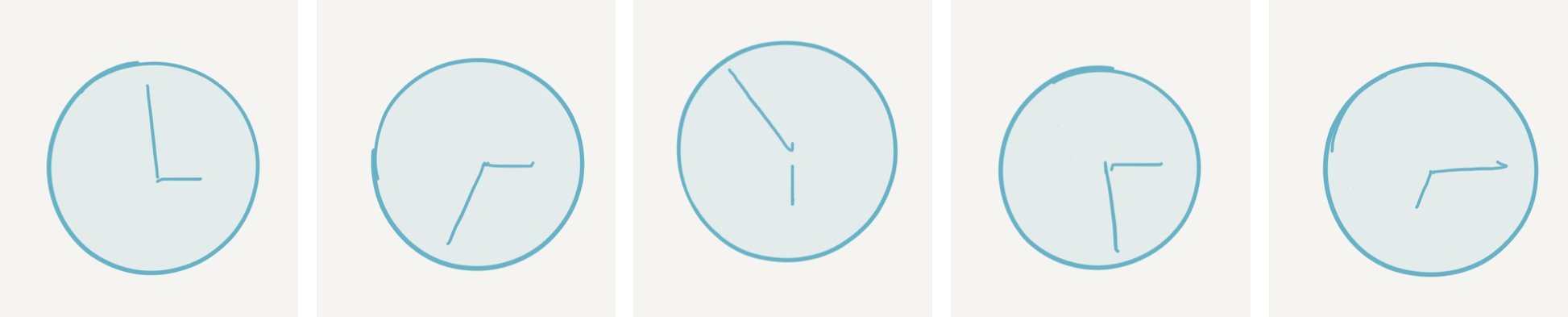
- 1.https://en.wikipedia.org/wiki/Lo_mai_gai ↩
- 2.https://zh.wikipedia.org/wiki/節瓜 ↩
- 3.The Cantonese Pinyin romanization system. https://en.wikipedia.org/wiki/Cantonese_Pinyin ↩
- 4.People in Hong Kong tend to leave out “個字” (“字” here simply means the numbers on the clock face). ↩